
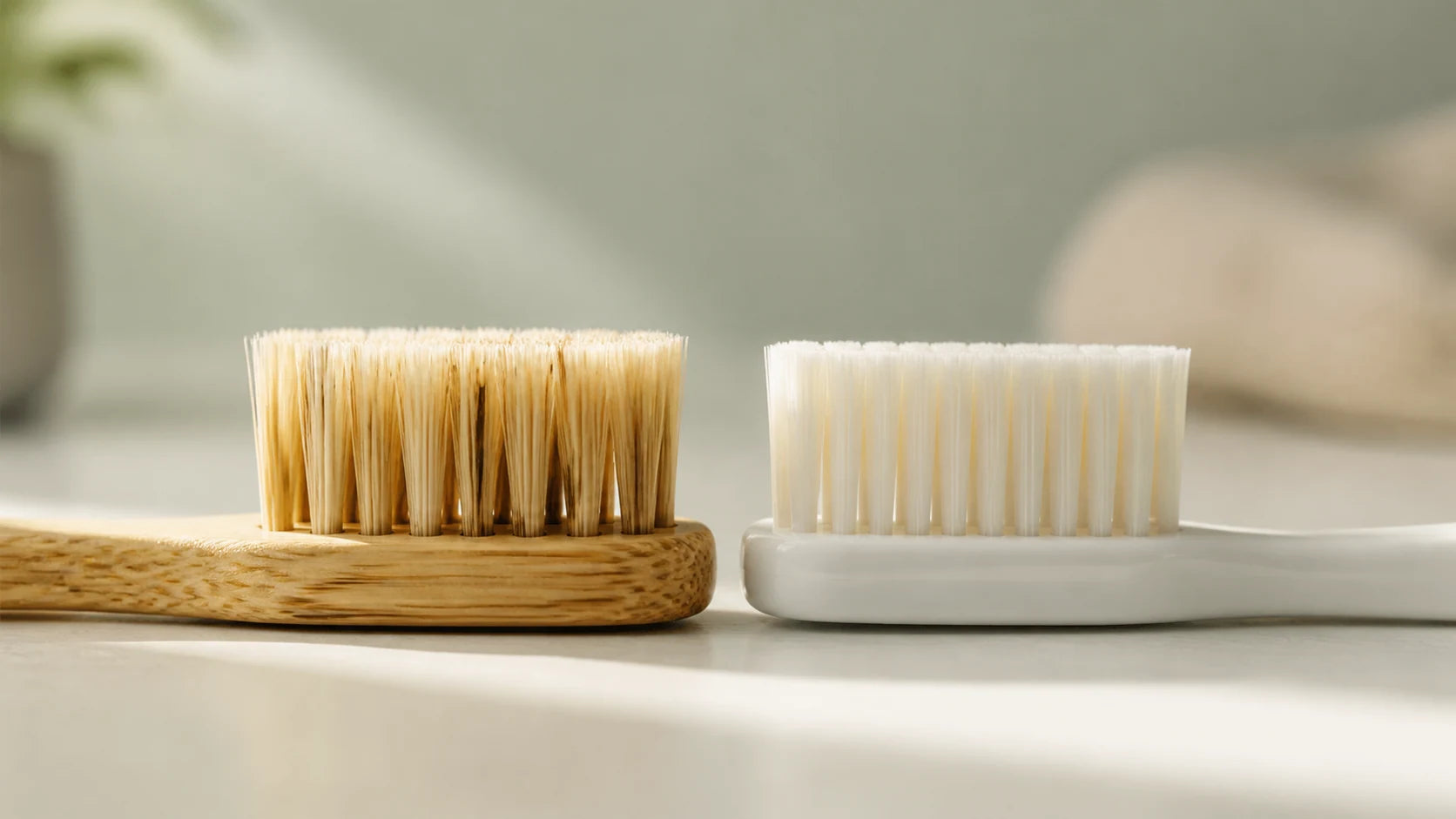
A boar-bristle toothbrush is plastic-free at the bristle; a nylon brush is more standardised and has the stronger, though very old, direct evidence for plaque removal. The fairest boar bristle vs nylon toothbrush comparison is therefore not “natural good, plastic bad.” It is a trade-off between limited cleaning evidence, softness and consistency, drying behaviour, animal origin, and avoidable plastic use.
The Bottom Line
Choose a soft nylon brush if proven, predictable cleaning performance is your priority. Consider boar bristle if avoiding polymer bristles matters more to you and you are willing to dry the brush carefully, accept animal origin and brush with deliberate technique.
What is the short answer?
Nylon has two practical advantages: manufacturers can control filament diameter, length, stiffness and end treatment, and the two direct human comparisons we found both leaned toward nylon for plaque removal. Boar hair has one clear material advantage: it is keratin, not a synthetic polymer, so a shed hair is not a microplastic fibre. Neither fact decides the whole question. Brush design, pressure, time, toothpaste and whether the bristles reach the gum margin all affect the result.
There is no modern clinical evidence base large enough to name either material universally “best.” The direct studies involved twelve people each and were published in 1977 and 1987. Current boar brushes may differ from the brushes tested, just as modern nylon brushes do. That does not make the old results irrelevant; it means they are a reason for caution, not a final verdict for every product sold today.
| Question | What the evidence supports | Confidence |
|---|---|---|
| Plaque removal | Two small direct comparisons favoured or tended to favour nylon | Low — old studies, 12 participants each |
| Gum safety | Soft and extra-soft brushes tend to cause fewer gingival lesions than hard brushes | Moderate for stiffness; not specific to boar |
| Bacteria | One material comparison found no significant difference in survival or growth | Low — limited material-specific evidence |
| Plastic release | Recent simulations measured particles from polymer-bristled commercial brushes | Moderate for release; low for personal-health consequences |
| Standardisation | Nylon diameter, trim and end treatment can be engineered consistently | High as a manufacturing property |
| Animal origin | Boar bristle is an animal-derived material | Certain |
| Best overall | Depends on the reader's priorities and the finished brush design | No universal answer |
Do boar bristles remove plaque as well as nylon?
The most direct study is also the least convenient result for a company that sells boar-bristle brushes. Arai and colleagues compared pig bristle, another animal bristle, nylon and rubber in twelve adults. Using the study's brushing method and plaque score, nylon removed an average of 59.6% of disclosed plaque. Pig bristle removed 42.3%. The reported difference between nylon and the other brush types was statistically significant.
Controlled comparison of four bristle materials using a scrub brushing methodLimited evidence
Arai T, Suzuki M, Hatabu T, Yokota M, Hasegawa K, Kinoshita S (1977)
Journal of the Japanese Society of Periodontology
Nylon removed 59.6% of disclosed plaque versus 42.3% for pig bristle.
n=12 adults
A separate 1987 comparison also tended to favour nylon, but no modern large replication was found.
A second twelve-person study published in 1987 compared three pig-bristle diameters with three nylon diameters. Nylon brushes tended to produce higher plaque removal and different brushing pressures. The clearest significant plaque difference occurred in the smallest-diameter comparison. That detail matters: “material” was not the only changing variable. Diameter, stiffness and the pressure a person naturally applies can move together.
Taken literally, the direct record does not support a blanket statement that boar and nylon remove equal amounts of plaque. It supports a narrower sentence: both removed plaque in small experiments, but the available comparisons tended to favour nylon. It would also be too strong to claim that nylon will outperform every current boar brush for every person. Those experiments are too small and too old for that.
The other side
“People often report that technique matters more than bristle material, and that is plausible: brushing duration, coverage and pressure clearly matter. But a general truth about technique cannot be used to erase a direct material comparison. The honest answer has to carry both facts: technique matters, and the limited head-to-head evidence did not show equivalence.”
Arai et al. 1977; Nakamura et al. 1987Are boar bristles gentler on gums?
“Natural” does not automatically mean gentle, and “nylon” does not automatically mean harsh. The variables a gum experiences are filament stiffness, end shape, arrangement and the force in the user's hand. A thick boar hair can feel firmer than an extra-soft synthetic filament. A poorly finished nylon brush can have rough ends, while a well-made one can be end-rounded or tapered. Compare the finished heads, not just the ingredient names.
The best broader evidence is a systematic review of thirteen controlled studies examining bristle stiffness and end shape. Hard-bristled brushes produced more gingival lesions than medium and soft brushes, and the reviewers concluded that soft and extra-soft brushes tend to be safer. They did not find that tapered bristles were universally safer than end-rounded ones. The review was about design characteristics across brushes; it did not establish a clinical advantage for boar hair.
That distinction changes how a buyer should use the evidence. If a particular boar brush feels soft under light pressure, it may suit someone who prefers that texture. But the material alone cannot justify claims that it reaches farther under the gumline, stops recession or cleans without abrasion. Those outcomes would require testing of the finished brush. If your gums bleed, recede or remain painful, ask a dental professional rather than using a material comparison as a diagnosis.
Do natural bristles hold more bacteria?
All used toothbrushes can carry microorganisms. That sounds alarming until the next sentence is included: finding bacteria on a brush is not the same as demonstrating that the brush makes an ordinary user ill. The American Dental Association notes both parts. It describes toothbrush contamination and also says there is no evidence that the bacteria found on toothbrushes cause adverse health effects.
Zinn, Schages and Bockmühl studied used brushes and laboratory contamination across different bristle materials, including pig bristle and nylon. Counts on used brushes were substantial, but bristle material had no significant effect on bacterial survival or growth in their comparison. User age and period of use affected the microbial community. This is useful evidence against the simplistic claim that animal hair necessarily becomes a uniquely dangerous bacterial reservoir.
It is not proof that storage never matters. Natural hair and synthetic filaments differ in water interaction, and the finished head includes densely packed tufts, anchor points and a handle. Rinse away debris, shake off water and stand either brush upright where air can circulate. Do not share a brush. Avoid a sealed travel case while it is wet. Someone who is immunocompromised or has been given specific oral-care instructions should follow their clinician's advice.
What does the microplastics evidence show?
Nylon is a polyamide: a synthetic polymer. Boar hair is mostly keratin: a protein fibre. That means a boar hair shed from a brush is not a microplastic. It does not prove a boar-bristle brush releases “nothing,” because whole hairs, keratin fragments or particles from another component could still detach. “No plastic bristles” is a material fact. “Zero particle shedding” is a finished-product performance claim and needs a finished-product test.
The evidence on polymer toothbrush shedding has improved. A 2025 laboratory study simulated twice-daily brushing against a zirconia dental arch and analysed particles using microscopy, infrared and Raman techniques. Every commercial toothbrush tested released microplastics, with material and structural design influencing the amount and form. The highest reported brand average was 39 particles per day. The experiment demonstrates release under its simulated conditions.
It does not establish a clinical dose, how many particles a person swallows, how long they remain in the mouth or whether that exposure produces harm. Some particles in real use would enter wastewater during rinsing. The study's discussion raises plausible biological concerns, but a hazard mechanism is not a measured health outcome. The defensible reason to avoid nylon here is reducing persistent polymer use and release—not promising a proven personal-health benefit.
Which material lasts longer and is easier to live with?
Nylon's consistency is valuable in a wet tool. Filaments can be made to a specified diameter and trim, and a synthetic head is comparatively forgiving if it stays damp. Natural hair varies between individual fibres and batches. A boar brush can soften and shape itself through use; it can also feel unfamiliar, retain moisture or shed an occasional loose hair, especially early in its life.
The replacement rule should follow condition rather than marketing. The ADA says about three to four months, or sooner if the bristles become matted or frayed. Eso currently recommends two to three months for its natural-bristle brush. Either way, inspect the head. Replace it when tufts splay, the texture changes enough to affect coverage, attachment becomes loose, an odour persists after complete drying, or your dental professional tells you to use a different schedule.
Do not boil, microwave or dishwash a natural-bristle bamboo brush. Heat can alter keratin and split or distort the handle. Routine soaking is also a poor default for a material that needs to dry. Ordinary care is less dramatic: rinse the head, remove visible debris, shake it firmly and store it upright in open air. Pack it only after it has dried.
What are the environmental and ethical trade-offs?
A boar-bristle head avoids synthetic bristle polymer, but that is not a complete lifecycle assessment. The animal source, collection method, cleaning, transport, tuft anchoring, handle treatment, packaging and disposal route all matter. “Biodegradable” also depends on conditions and time. A material may break down in an active composting environment and persist much longer in a dry landfill.
The ethical question cannot be answered by calling bristle a by-product. Buyers may want to know the animal species, country and industry of origin, whether hair is collected after slaughter or during another process, which welfare standard applies, how batches are cleaned, and what documentation follows them. Until a seller publishes supplier-specific evidence, claims such as ethical, cruelty-free or harmless by-product are assertions rather than traceability.
Boar bristle is not vegan and may be unacceptable for religious, cultural or personal reasons. Nylon avoids animal material but uses persistent polymer. Castor-oil-derived nylon is still polyamide: changing some fossil feedstock does not turn the finished filament into plant fibre or make it readily compostable. There is no value-neutral option; there are different costs, and the honest label should make them visible.
How should you choose?
A soft nylon brush is the clearer choice if
- You want the material with the better direct plaque-removal result, despite weak and old evidence
- You need highly consistent softness and filament geometry
- You prefer an animal-free product
- You travel frequently or cannot reliably air-dry a natural brush
- Your dentist has recommended a particular tested brush design
A boar-bristle brush may suit you if
- Avoiding polymer bristles is a firm environmental priority
- You accept animal-derived material and have checked the sourcing information available
- You are comfortable with natural variation and occasional loose hairs
- You will rinse and air-dry the head carefully
- You understand that clinical equivalence to nylon has not been established
Whichever material you choose, use a soft head and light pressure, reach every surface for about two minutes twice a day, and use the toothpaste your dental professional recommends. A material swap cannot compensate for missed surfaces or a worn head. If a new brush makes your gums sore, produces persistent bleeding, leaves plaque you can feel or encourages you to scrub harder, stop treating adaptation as a virtue and change the brush or ask for advice.
What does Eso World sell, and what remains unproven?
Eso World sells a bamboo-handled boar-bristle toothbrush, so we have a commercial interest in this comparison. That is why the unfavourable plaque results appear near the top rather than at the bottom. Our brush removes polymer bristles and uses a pressure-fitted construction. Those are product specifications. They do not demonstrate equal plaque removal, better gum outcomes or a personal-health benefit.
Several useful tests remain to be done on the finished product: independent plaque and gingival outcomes against a named soft nylon control; filament-diameter and end-shape microscopy across batches; retained-moisture measurements under realistic storage; tuft-retention and particle-shedding tests; and degradation testing under named conditions. Supplier traceability should also be published separately from performance evidence. Until then, those questions stay open.
The evidence-led position is deliberately narrower than a sales claim: boar bristle removes plastic from the bristle material, while soft nylon remains the more standardised option and performed better in the limited direct plaque studies.
The bottom line
For most people seeking the conventional evidence-based default, a reputable soft nylon toothbrush is easier to recommend. A boar-bristle toothbrush is a values-led alternative for someone prioritising plastic avoidance and willing to accept its animal origin, care requirements and evidence gaps. The available research does not justify calling boar superior, unsafe, equivalent or ineffective as a universal statement. It justifies a careful choice.
References
Arai T, Suzuki M, Hatabu T, Yokota M, Hasegawa K, Kinoshita S (1977)
The Plaque-Removing Effect of Natural and Synthetic Bristle Toothbrushes
Journal of the Japanese Society of Periodontology
Suzuki J, Watanabe T, Watanabe I, Shoji Y, Fukushima M, Arai T, Nakamura J (1987)
Studies on the Effect of Different Kinds of Toothbrushes on Plaque Removal and Toothbrushing Pressure in Scrubbing Method of Toothbrushing (Report 3)
Journal of the Japanese Society of Periodontology
Ranzan N, Muniz FWMG, Rösing CK (2019)
Are bristle stiffness and bristle end-shape related to adverse effects on soft tissues during toothbrushing? A systematic review
International Dental Journal
Zinn MK, Schages L, Bockmühl D (2020)
The Toothbrush Microbiome: Impact of User Age, Period of Use and Bristle Material on the Microbial Communities of Toothbrushes
Microorganisms
Aytulun CÖ, Dana PA, Gachayzade Z, Gedik K, Balci N, Toygar H (2025)
Preliminary results on microplastic release from commercial toothbrushes during simulated brushing
Microchemical Journal

