Skip to content
Eso World

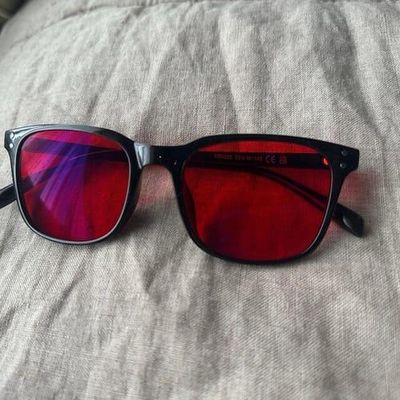
Your phone emits 460–480nm light — the exact wavelength that suppresses melatonin by up to 85%. Clear ‘blue light’ glasses block 5–15%. These block 99.9%.. Red lens blue light glasses. Made from TR90 Nylon, Red Polycarbonate Lens, Stainless Steel Hinges. Free from BPA / BPS / BPF, Polycarbonate frame, Clear or yellow lenses, Lead-based lens tinting, Phthalate plasticisers. Your phone, laptop, and TV emit light at 460–480nm — the exact wavelength that suppresses melatonin production by up to 85% (Cajochen et al., 2011). 5 verified customer reviews, 5/5 average. £34.79 with free UK shipping.

Blue Light Blocking Glasses | Red Lens product image

Blue Light Blocking Glasses

Eso-FriendlyOne size fits most
3 materials6 excluded5 reviews5 studies

Your phone emits 460–480nm light — the exact wavelength that suppresses melatonin by up to 85%. Clear ‘blue light’ glasses block 5–15%. These block 99.9%.

£34.79

Quantity

1

£34.79

Ships within 24 hours30-day returnsFree delivery

Blue Light Blocking Glasses

£34.79

A sturdy pair of glasses and as described. I wasn’t sure or not if to expect a case as one is not mentioned in the descr...Tommy

Red lens blocks 99.9% of blue light at 460Melatonin production begins within 30Clinically demonstrated sleep improvement in RCTs

Free from: BPA / BPS / BPF, Polycarbonate frame, Clear or yellow lenses, Lead-based lens tinting + 2 more

Best for: You use screens in the evening and struggle to fall asleep, You’ve tried yellow or clear ‘blue light’ glasses and they didn’t help, Shift workers or anyone with irregular sleep patterns

Lens

Red, 400–530nm blocking

Frame

TR90 (BPA-free)

Blocking

99.9% blue light

Weight

~25g

What's In It

3 materials. Nothing else.

The Blue Light Blocking Glasses is made from TR90 Nylon, Red Polycarbonate Lens and Stainless Steel Hinges. Every material is published here with its function and percentage.

Your phone, laptop, and TV emit light at 460–480nm — the exact wavelength that suppresses melatonin production by up to 85% (Cajochen et al., 2011). This isn’t a vague ‘blue light is bad’ claim. It’s a measured, dose-dependent suppression of the hormone that controls your sleep onset. Clear and yellow ‘blue light glasses’ block 20–40% of this wavelength. Red lenses block 99.9%. The research difference between partial and full blocking is not 2× — it’s the difference between melatonin suppression continuing and melatonin production beginning.

What We Left Out

6 substances we don't use.

The Blue Light Blocking Glasses is free from BPA / BPS / BPF, Polycarbonate frame, Clear or yellow lenses and Lead-based lens tinting and 2 other substances. Each exclusion is explained below with the reason.

Verified Reviews

5.0

5 verified reviews

5 out of 5 stars

A sturdy pair of glasses and as described. I wasn’t sure or not if to expect a case as one is not mentioned in the description. For those wondering, a case is not included. Still, I’m very happy with my purchase!

Review by Tommy
T

Tommy

Verified buyer

5
100%
4
0%
3
0%
2
0%
1
0%
How We Compare

Eso World vs. typical products.

 Eso WorldTypical
Lens colourRed (blocks 400–530nm)Clear or yellow (blocks <50%)
Blue light blocked99.9%20–40% (marketing claim)
Designed forEvening use (melatonin support)All-day wear (minimal benefit)
Full material disclosureYesNo

Comparison summary: Lens colour: Eso World uses Red (blocks 400–530nm), typical alternatives use Clear or yellow (blocks <50%). Blue light blocked: Eso World uses 99.9%, typical alternatives use 20–40% (marketing claim). Designed for: Eso World uses Evening use (melatonin support), typical alternatives use All-day wear (minimal benefit). Full material disclosure: Eso World uses yes, typical alternatives use no.

How to Use

Getting started.

1

Put them on 1–2 hours before bed

That’s when it matters. Your body needs 1–2 hours without blue light to start producing melatonin.

2

Wear them for all screen time

Phone, TV, laptop, overhead LED lights — all emit blue light. Keep the glasses on for all of it.

3

Everything will look red

That’s the point. You adjust in about 5 minutes. It feels strange the first night, then you stop noticing.

4

Take them off and go to sleep

When you’re ready for bed, remove the glasses and keep the lights off. Your melatonin is already flowing.

What to Expect

The first 4+ weeks.

1

Falling asleep faster

Most people notice a difference within 2–3 nights. You’ll feel drowsier at your intended bedtime instead of lying awake. The red tint feels odd for the first evening, then you stop caring.

2–4

Sleep quality improves

It’s not just about falling asleep — your sleep architecture shifts. More time in deep sleep, less waking during the night. Morning grogginess often improves around this point.

4+

It’s just part of your evening

You put them on at 9pm without thinking about it. The difference is most obvious when you forget them for a night and notice how much harder it is to switch off.

Questions & Answers

8 questions answered.

Yes — but only if they block enough. Burkhart & Phelps (2009) demonstrated that amber/red lenses improve sleep quality in an RCT. Chang et al. (2015) showed screens suppress melatonin dose-dependently. The key: clear lenses block 5–15% of the 460nm peak. Yellow blocks 20–40%. Red blocks 99.9%. The research showing sleep improvement used lenses that blocked the full 400–530nm range — which is what ours do.

The melanopsin photoreceptors in your retina (ipRGCs) that control melatonin suppression are most sensitive at 460–480nm. Clear coatings and yellow tints leave most of this wavelength untouched. Red lenses remove it entirely. The 2009 Burkhart & Phelps study used amber lenses (similar spectrum to red). Shechter et al. (2018) replicated with amber lenses and found clinically significant sleep and mood improvements.

1–2 hours before your intended sleep time. Melatonin onset takes approximately 30–90 minutes after blue light exposure stops (Cajochen et al., 2011). Wearing them during your evening wind-down routine — TV, phone, reading on a tablet — lets melatonin build naturally.

They’re designed for evening use only. Daytime blue light exposure is important for circadian rhythm regulation, alertness, and mood. Blocking it during the day would be counterproductive.

If your insomnia is related to screen use and circadian disruption, yes. Shechter et al. (2018) showed significant sleep improvement in insomnia patients wearing blue-blocking glasses for just 2 hours before bed over 7 nights. If your insomnia has other causes (anxiety, pain, medical conditions), glasses alone won’t solve it.

Software night modes (Apple Night Shift, Android Night Light, f.lux) reduce blue light emission by 20–60%. Better than nothing, but they don’t eliminate it. Glasses filtering at the eye block 99.9% regardless of which screen you’re looking at — TV, phone, laptop, smart home displays, LED room lighting.

Yes. Red lenses filter blue wavelengths; they don’t emit anything. Your eyes receive the same visible light minus the 400–530nm band. There is no UV component. Tosini et al. (2016) actually suggested blue light filtering as protective against cumulative retinal damage.

These are standard frames, not fit-overs. If you wear prescription glasses, you’d need clip-on red filters or prescription blue-light-blocking lenses from your optician.

The bottom line

The Blue Light Blocking Glasses is made from TR90 Nylon, Red Polycarbonate Lens, Stainless Steel Hinges. Free from BPA / BPS / BPF, Polycarbonate frame, Clear or yellow lenses. Every material is published on this page with the research behind each choice. 5 verified buyers rate it 5/5.

3 materials — nothing else6 substances excluded5 verified reviews — 5/55 cited studies
Free shipping over £10.00
30-day returns
Every material published

Burkhart K, Phelps JR (2009)

Chronobiology International

Amber-tinted lenses that block blue light significantly improved sleep quality and mood in participants with insomnia. The study demonstrated that filtering wavelengths below 530nm allowed earlier melatonin onset and improved subjective sleep scores compared to clear control lenses. This was one of the first RCTs linking blue-light filtering eyewear to measurable sleep improvement.

Chang AM, Aeschbach D, Duffy JF, Czeisler CA (2015)

Proceedings of the National Academy of Sciences

Using light-emitting eReaders before bed suppressed melatonin, delayed circadian rhythm, reduced next-morning alertness, and increased sleep onset latency compared to reading printed books. The effect was dose-dependent: more screen time = more suppression. Participants took an average of 10 minutes longer to fall asleep on eReader nights.

Cajochen C, Frey S, Anders D, Späti J, Bues M, Pross A, Mager R, Wirz-Justice A, Stefani O (2011)

Journal of Applied Physiology

LED-backlit screens suppressed melatonin by 55% compared to non-LED screens in a controlled crossover study. The suppression was specific to the 460–480nm wavelength range. Cognitive arousal (measured by EEG) was also higher after LED screen exposure, suggesting blue light affects both hormonal and neurological sleep readiness.

Shechter A, Kim EW, St-Onge MP, Westwood AJ (2018)

Journal of Psychiatric Research

Wearing amber-tinted blue-light-blocking glasses for 2 hours before bed for 7 nights significantly improved sleep quality and mood in patients with bipolar disorder and insomnia. This demonstrated that the effect of blue-light filtering extends beyond sleep latency to clinically meaningful mental health outcomes.

Tosini G, Ferguson I, Tsubota K (2016)

Molecular Vision

Blue light exposure causes retinal damage through photochemical mechanisms involving reactive oxygen species in retinal pigment epithelial cells. The damage is cumulative and wavelength-specific, peaking at 415–455nm. Long-term implications include increased risk of age-related macular degeneration. The authors recommended reducing blue light exposure during evening hours.

Read our research →

These are blue-light glasses, not a medical device. See a healthcare professional for persistent sleep issues.